
Most of us know what it is like to be at odds with ourselves. We decide to stop worrying, yet the mind returns to the same uncertainty. We recognize that a habit is hurting us, yet still feel drawn toward it. We want closeness but become guarded when intimacy makes us vulnerable. A few ambiguous words can tighten the body and begin to feel like rejection before we have consciously decided what they mean.
We usually speak about mental life as though it were directed by a single, unified agent. We say, “I thought,” “I decided,” and “I acted,” as if a central self independently initiated each event. Closer observation reveals a more complicated process. Thoughts appear without being requested. Feelings make some possibilities seem urgent and others unimportant. The body prepares for action while memories, expectations, and competing motives shape what happens next.
This does not leave us powerless. It means that agency operates within a larger network of causes and conditions. We inherit broad motivational sensitivities; relationships and cultures shape how they develop; bodily states influence what feels threatening or manageable; and actions that bring reward or relief become more likely to recur.
The human condition includes love, creativity, play, cooperation, moral concern, and the search for meaning—not only reactivity and suffering. This article focuses on one central dimension of that larger condition: how biological inheritance, developmental history, bodily life, culture, perception, and learning combine to shape experience, and how different conditions can make different responses possible.
Drawing from contemporary psychology, evolutionary theory, cognitive science, learning theory, embodied approaches to the mind, and Buddhist psychology, the framework moves from inherited human priorities to personal patterns of perception and behavior. It then considers how ethics, meditation, and wisdom can help us participate more consciously in processes we never completely control.
Understanding the Human Condition Requires More Than One Model
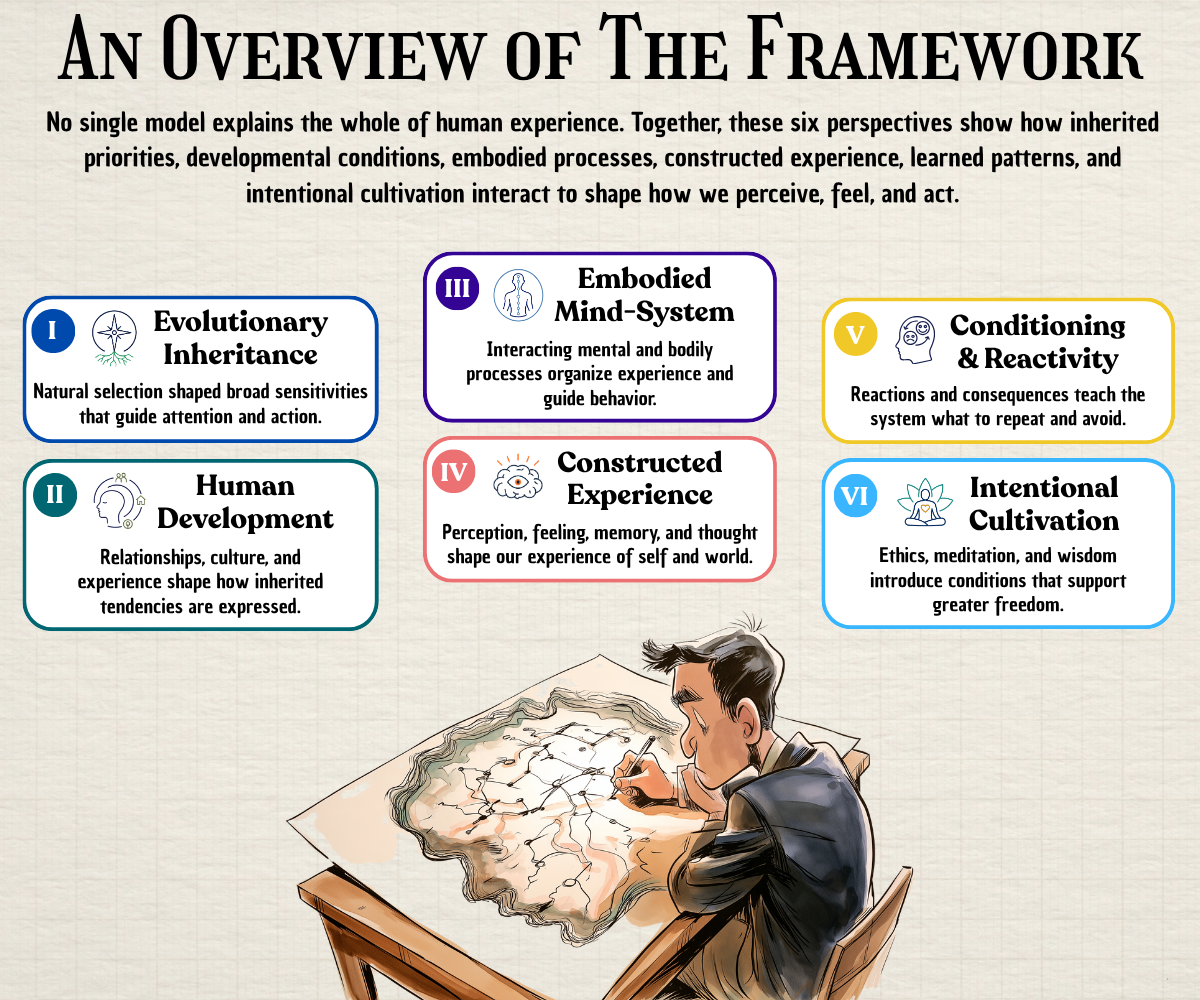
No single theory can adequately explain the human condition because the same experience unfolds across several interconnected levels.
Imagine receiving a message from someone important to you: “Can we talk tomorrow?” Nothing in those words explicitly announces danger. Even so, the body may tighten, an unpleasant feeling may arise, and the mind may begin anticipating conflict, rejection, or loss.
An evolutionary perspective can help explain why interpersonal uncertainty captures attention so readily. Developmental psychology can show why the message feels manageable to one person and threatening to another. An embodied perspective examines how arousal, emotion, thought, and action influence one another, while cognitive psychology investigates how attention, memory, and expectation shape what the message appears to mean. Learning theory explains why checking, reassurance-seeking, or avoidance may bring immediate relief while increasing future sensitivity to uncertainty. Buddhist psychology follows the experience from contact and feeling tone into craving, aversion, clinging, and suffering.
Each approach asks a different question. Evolutionary models investigate why certain sensitivities recur across human beings. Developmental and cultural models examine how a shared inheritance acquires a particular form within one life. Cognitive and embodied approaches explore how experience is organized in the present. Learning theory describes how consequences alter future responses. Contemplative traditions investigate what can be discovered when these processes are observed from within and placed in an ethical and liberative context.
These models sometimes overlap, but they should not be collapsed into one explanation. Meditation offers a disciplined way of examining experience from the first-person perspective; science depends upon measurement, controlled comparison, and publicly examinable evidence. Science can clarify mechanisms without deciding what makes a life ethical or meaningful, while contemplative insight cannot by itself establish a scientific conclusion.
The models are therefore best treated as maps: selective representations that clarify particular features of a landscape without exhausting the reality they describe. Together, they trace a movement from evolutionary inheritance through development, embodied mental activity, constructed experience, and conditioning. Ethics, meditation, and wisdom then introduce conditions through which established patterns may loosen and new responses become possible.
I. Evolutionary Inheritance — What Basic Priorities Shape Human Motivation?
Before we can describe a personal history or cultural identity, we are already capable of detecting and learning about what matters. Human beings enter life prepared to respond to nourishment and danger, attachment and separation, acceptance and exclusion, status, sexuality, caregiving, and other recurring concerns.
This inheritance is not a script for behavior. It consists of broad capacities and sensitivities that develop through experience. Family, culture, environment, and personal history help determine what comes to represent safety, success, belonging, intimacy, or threat.
Evolutionary psychology offers one perspective on why these priorities exist. Not every behavior is an adaptation, and hypotheses about the distant past vary in evidential strength. Its central contribution remains important: the human mind developed through the practical demands of embodied and social life.
Natural Selection Shaped the Mind for Adaptive Action—Not Lasting Contentment:
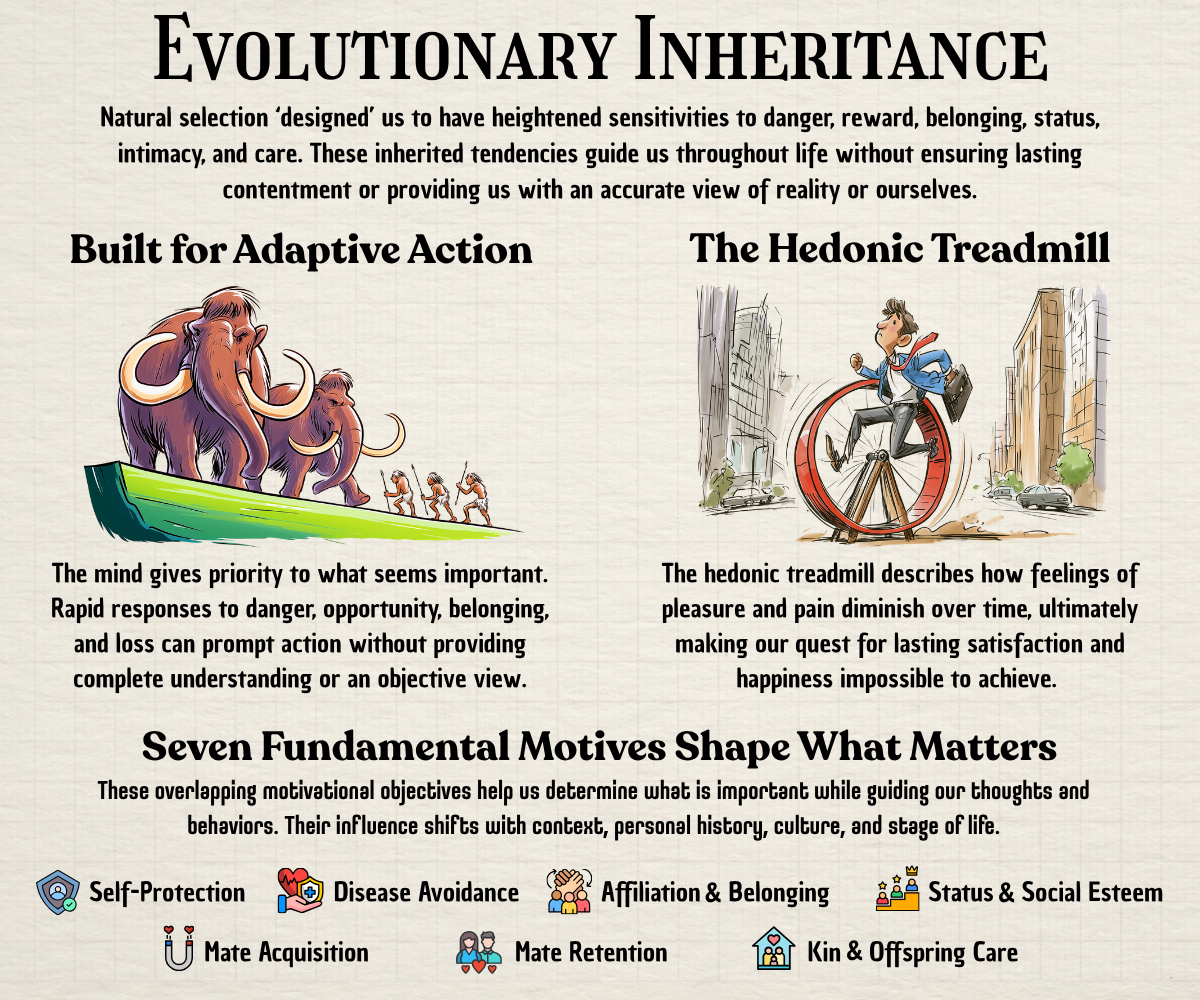
Natural selection has no foresight or concern for human happiness. Across generations, inherited characteristics that contributed to survival and reproduction were more likely to persist. The resulting mind-body system did not need to produce a complete or impartial picture of reality. It needed to guide behavior well enough for human beings to recognize danger, pursue opportunities, maintain relationships, and care for dependents.
Accuracy still matters, but perception and attention are selective. The mind prioritizes information that appears consequential, especially when overlooking it could be costly. A rustle in the grass may provoke fear when no danger is present because occasional false alarms can be less costly than repeatedly failing to notice a real threat.
Feelings are part of this guidance system. They help register whether something appears beneficial or harmful, inviting or threatening, worth approaching or best avoided. Hunger directs attention toward food, fear prepares protection, loneliness makes disconnection difficult to ignore, and affection supports attachment and care.
Feelings therefore carry rapid evaluations of what an event means for the organism experiencing it. Their function is not to provide a detached verdict about reality but to make certain features of a situation matter. A feeling can be entirely real while the assessment it carries is incomplete or mistaken. Fear does not prove that danger is present; shame does not establish that the self is defective; desire does not guarantee that obtaining its object will improve a life.
Evolutionary explanations distinguish between ultimate outcomes and proximate motives. Survival and reproduction may help explain why a capacity persisted, but people experience attraction, jealousy, fear, tenderness, ambition, loneliness, and the desire to belong—not an intention to maximize evolutionary fitness.
The same distinction helps explain why adaptive capacities do not ensure lasting contentment. Pleasure can reinforce useful behavior, but permanent satisfaction would make an organism less responsive to new needs, risks, and opportunities. The capacities that support protection, attachment, achievement, and care can enrich life while keeping motivation—and dissatisfaction—in motion.
Fundamental Motivational Systems Organize Recurring Human Priorities:
Evolution did not leave human beings with one general drive for survival. Motivation appears to be organized around several recurring domains that sensitize attention, emotion, and behavior to different opportunities and threats. One influential but non-exhaustive account, the Fundamental Motives Framework, identifies seven broad domains:
- Self-protection: detecting and responding to possible physical danger
- Disease avoidance: avoiding contamination, infection, and illness
- Affiliation and belonging: forming friendships and maintaining social acceptance
- Status and social esteem: gaining respect, competence, influence, and recognition
- Mate acquisition: pursuing romantic or sexual connection
- Mate retention: maintaining valued intimate bonds
- Kin and offspring care: protecting and supporting children and relatives
These categories are not seven isolated brain systems, nor do they explain every human aspiration. They identify recurring concerns around which perception, feeling, thought, and behavior can become organized.
Each domain can evoke different emotions and action tendencies. Danger may produce fear, contamination disgust, exclusion loneliness, and status concerns pride, shame, or envy. Caregiving can involve tenderness and devotion alongside worry, exhaustion, and grief. Feelings give these concerns immediacy.
The motives also overlap and compete. A person may want intimacy yet withdraw when closeness activates fears of rejection. The desire for recognition may support achievement while straining relationships. Protecting a child can outweigh comfort, status, or personal safety. Much of what feels like inconsistency reflects several concerns pulling behavior in different directions.
Development and culture determine how these priorities are expressed. Status may be pursued through wealth, knowledge, beauty, service, spiritual attainment, or moral reputation. Belonging may center on family, friendship, nationality, religion, politics, or an online community. The concern may recur while its meaning varies widely.
This framework also challenges the claim that evolution made human beings exclusively selfish. Attachment, empathy, cooperation, reciprocity, and caregiving are as much a part of our inheritance as competition and self-protection. Yet constructive motives can still create difficulty: care can become control, belonging can demand conformity, and ambition can make worth dependent upon achievement.
The framework is most useful as a map of recurrent human priorities, not as a theory reducing every choice to one evolutionary function. Motivation is also shaped by language, reflection, institutions, ethical commitments, and the meanings people create together.
Approach, Avoidance, and Reward Keep Motivation in Motion:
Fundamental motives describe what the mind treats as important. Approach and avoidance describe two basic directions in which those concerns move us. We are drawn toward anticipated nourishment, intimacy, recognition, pleasure, and relief while pulling away from pain, danger, rejection, uncertainty, and loss.
Feelings help translate these concerns into immediate priorities. Attraction makes something seem worth pursuing. Fear and disgust encourage distance. Anger prepares confrontation, while anxiety keeps attention near an unresolved possibility. These responses operate partly as implicit judgments: This matters. This could help me. This could harm me. Do something.
Their guidance can be intelligent without being infallible. Feelings reflect inherited sensitivities as shaped by learning and present conditions. They can respond to genuine needs and dangers, but they can also produce false alarms, apply an old lesson to a new situation, or be recruited by environments unlike those in which the underlying tendencies developed.
Approach and avoidance often operate together. Someone may pursue achievement because success feels rewarding and failure feels intolerable. A person may seek closeness while guarding against vulnerability. Divided motivation is frequently a conflict among different concerns, time horizons, and anticipated feelings rather than a simple contest between reason and irrationality.
Attention follows these priorities. Danger and loss can interrupt consciousness more readily than familiar signs of safety. Criticism may remain vivid after several compliments have faded. Often described as a negativity bias, this tendency varies with context, relevance, uncertainty, and what a person has learned to fear.
Immediate consequences also carry disproportionate weight. Through temporal discounting, pleasure or relief available now may feel more compelling than a larger but distant benefit. Research further distinguishes wanting from liking: pursuit can remain strong even when enjoyment is brief or declining. Research on reward processing helps explain why anticipation can become more powerful than satisfaction.
Even genuine pleasure changes as favorable conditions become familiar. Through hedonic adaptation, a new possession becomes ordinary and an achievement becomes the starting point for another comparison. Improved circumstances rarely bring desire to a permanent end.
Buddhist psychology approaches these movements from another level. Rather than explaining why motivational sensitivities evolved, it examines how pleasant, unpleasant, and neutral experiences are met from moment to moment. Evolutionary inheritance gives motivation broad sensitivities and direction; development gives those sensitivities a personal history and form.
II. Human Development — How Do Experience, Relationships, Culture, and Environment Shape Who We Become?
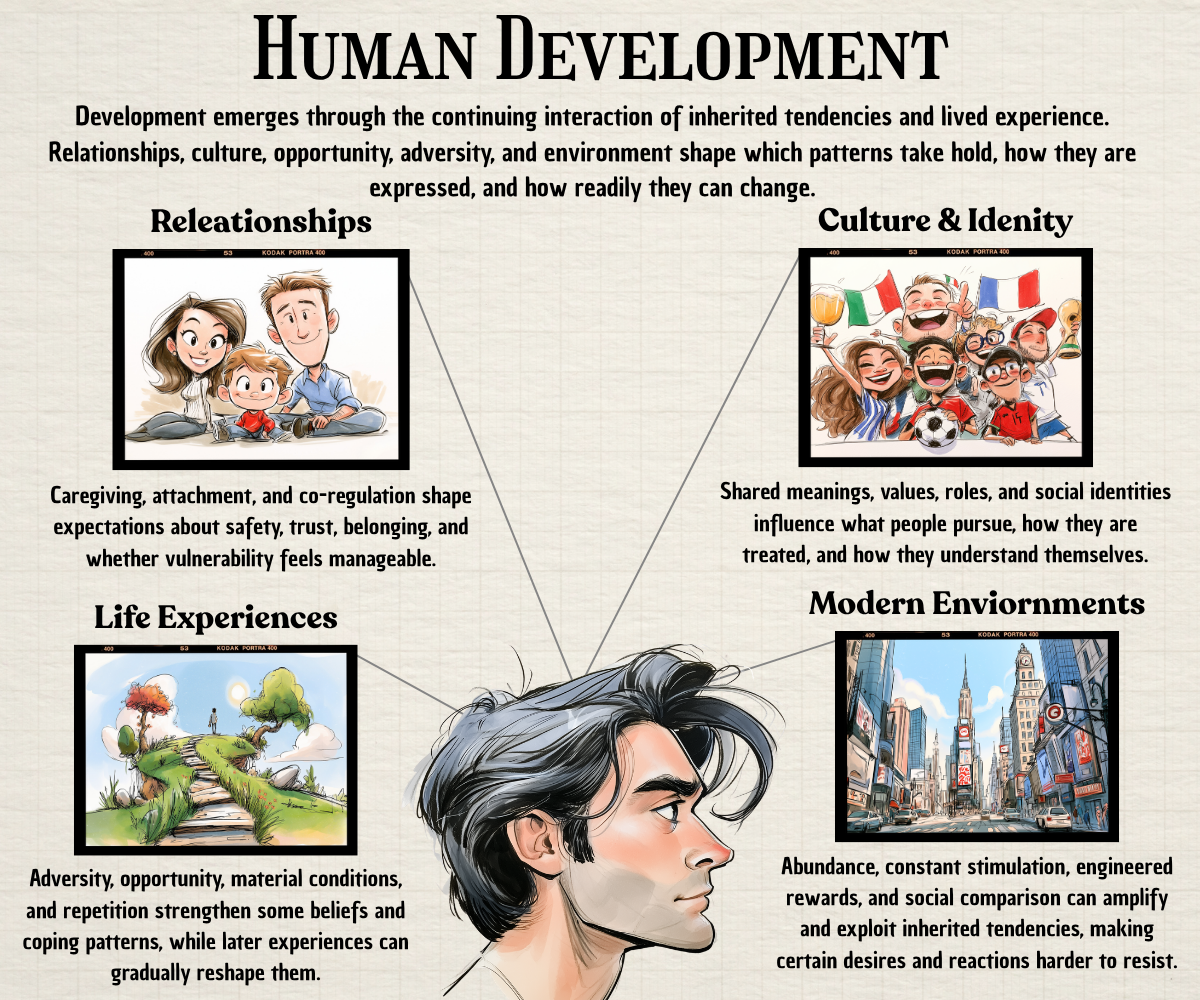
A shared evolutionary inheritance does not produce one universal way of being human. People differ in what draws their attention, how strongly they respond to uncertainty, what makes them feel valued, and whether closeness feels comforting, threatening, or both.
Evolution provides broad capacities for fear, attachment, pleasure, shame, desire, care, and social concern. Development helps determine what evokes these feelings, how intensely they are experienced, and what a person learns to do when they arise. A raised voice may be mildly unpleasant to one person and physically alarming to another.
These differences emerge through a continuing interaction among temperament, experience, relationships, culture, and circumstance. Development gives a personal history to inherited priorities: the need for belonging becomes an expectation about whether others can be trusted, while sensitivity to threat becomes vigilance toward particular cues.
Development Emerges Through the Interaction of Inheritance and Experience:
Human development cannot be divided neatly into what is biological and what is learned. Genes influence how an organism develops within an environment; they do not provide complete instructions that unfold independently of experience. Relationships, nutrition, stress, education, culture, opportunity, and physical surroundings all participate in how inherited potentials are expressed.
Temperament offers an early example. Some infants are especially sensitive to stimulation, cautious in unfamiliar situations, or slow to recover from distress. Others are more sociable or comfortable with novelty. These differences influence both how children encounter their surroundings and how caregivers respond to them.
The same sensitivity can develop differently under different conditions. With patient and predictable support, a highly sensitive child may become attentive to nuance and deeply responsive to others. In a chaotic or punitive environment, that sensitivity may contribute to vigilance, inhibition, or withdrawal.
Children also influence the environments shaping them. A socially responsive child may invite more interaction, while a child who becomes easily overwhelmed may evoke protection, frustration, distance, or careful accommodation. Siblings can therefore inhabit different psychological worlds despite sharing a household.
Developmental plasticity allows experience to alter attention, expectation, emotional response, and behavior across the lifespan. New relationships, responsibilities, losses, environments, and practices continue influencing how people respond. Research on developmental plasticity also recognizes limits: biology, earlier learning, health, circumstance, and available resources affect what can change and how readily. Plasticity makes development conditional, not infinitely malleable.
Relationships Shape Expectations About Safety, Connection, and Worth:
Some of our earliest learning occurs before we can explain what is happening. Infants depend upon caregivers not only for nourishment and protection but also for help regulating distress. Repeated experiences of being soothed, ignored, frightened, or met inconsistently begin shaping what a child expects from closeness.
This process of co-regulation helps establish the foundation from which self-regulation develops. Secure development does not require flawless caregiving. What matters is the broader pattern through which needs are recognized, disruptions are repaired, and difficult states become manageable within connection.
Attachment theory examines how these experiences contribute to expectations about whether support will be available and vulnerability is safe. They can influence whether someone seeks comfort, becomes preoccupied with rejection, distances themselves from dependence, or moves flexibly between connection and autonomy. Attachment patterns are not fixed personality types; a meta-analysis of attachment stability found both continuity and meaningful change from infancy into early adulthood.
Relationships also teach which emotions may be expressed, how disagreement is handled, whether mistakes invite guidance or humiliation, and what seems necessary to preserve belonging. Over time, these lessons contribute to schemas and core beliefs about the self, other people, and the world. Repeated criticism may teach that worth depends upon flawless performance, while emotional dismissal may teach that needing others is dangerous.
These conclusions are rarely chosen deliberately. They often begin as practical attempts to remain safe or connected within the relationships available at the time. Trauma and chronic adversity can intensify this learning, making vigilance, numbing, appeasement, control, or avoidance understandable responses to conditions in which openness carried genuine risk. Their earlier function does not make later consequences harmless, but it places the pattern within a history rather than treating it as a defective self.
Identity Develops Within Cultural, Social, and Material Worlds:
Development never occurs only within an individual or family. People grow within neighborhoods, schools, religious communities, economies, institutions, media environments, political systems, and historical periods. These settings shape the opportunities, pressures, resources, and restrictions through which a life unfolds.
Urie Bronfenbrenner’s bioecological approach places the person within interacting environments extending from immediate relationships to wider institutions, cultures, and historical change. Contemporary reviews of the model emphasize the interaction of person, process, context, and time.
Culture supplies many of the categories through which people understand themselves. It teaches what counts as success, maturity, beauty, morality, independence, devotion, and belonging. Social identities involving nationality, ethnicity, race, gender, class, religion, profession, and community can provide meaning and solidarity while influencing whose approval matters, what opportunities appear possible, and how someone is treated by others.
The self is therefore never entirely private. A career choice may reflect cultural assumptions about prestige or respectable adulthood. Someone may evaluate their body through standards repeated by family, peers, advertising, and media. A spiritual practitioner may judge their inner life against ideals absorbed from teachers, texts, and communities.
Material circumstances shape development just as deeply. Financial insecurity, discrimination, unsafe housing, unstable work, inadequate healthcare, environmental hazards, and violence impose demands that cannot be reduced to distorted thinking or poor emotional regulation. Individual responsibility remains meaningful, but choices arise within unequal fields of security, support, and opportunity.
The Buddhist teaching of dependent arising offers a complementary perspective: no person is entirely self-created. Who we become depends upon bodies, caregivers, language, relationships, labor, institutions, and countless forms of support. Recognizing this interdependence can soften self-blame while making social responsibility more visible.
Modern Environments Amplify and Exploit Inherited Tendencies:
Human motivational systems now operate within environments capable of stimulating them with unusual intensity, variety, and continuity. Artificial light can disrupt biological rhythms, abundant food continually activates appetite, and large social networks expose people to constant information about status, appearance, conflict, and group opinion.
Some environments are deliberately constructed to capture attention, provoke desire, produce relief, and encourage repeated consumption. Businesses can test which flavors, images, rewards, messages, and interface designs most reliably keep people eating, watching, purchasing, or returning. Feelings that once guided behavior toward occasional opportunities can now be activated repeatedly, measured, and converted into profit.
Food manufacturers can combine flavor, texture, convenience, and concentrated ingredients in ways that encourage continued consumption. In a controlled inpatient study, participants ate more and gained more weight on an ultra-processed diet than on a minimally processed diet matched across several nutritional dimensions. The findings show how food design can influence consumption beyond conscious intention. Alcohol and other recreational drugs can similarly recruit ordinary desires for pleasure, belonging, lowered inhibition, or emotional relief through unusually direct means.
Digital environments intensify other sensitivities. Online pornography supplies a continually changing stream of sexual cues. Gambling products combine anticipation, uncertainty, and intermittent reward. Some video games use social ranking, time-limited opportunities, and randomized rewards to sustain attention and spending; research on gaming microtransactions suggests that features such as loot boxes carry particular risks.
Social media gathers novelty, belonging, approval, comparison, status, threat, and moral conflict into one continuously available environment. Notifications imply that something socially relevant may have happened, while likes and follower counts quantify approval. Research examining online behavior shows how social feedback can shape posting and return visits.
Platforms can measure clicks, pauses, purchases, and viewing time, allowing interfaces to be refined around the behavior they elicit. Autoplay, streaks, countdowns, defaults, and difficult cancellation processes can make continued engagement easier than stopping. The Federal Trade Commission has documented designs intended to steer or manipulate consumer choice.
Consumer culture also connects products with deeper concerns. Clothing can promise belonging, technology can signify competence, luxury can display status, and wellness products can offer the identity of someone disciplined or spiritually developed. Advertising rarely sells practical function alone; it links consumption with the person someone hopes to become.
These products and technologies are not equivalent or harmful in every form. Their effects depend upon design, pattern of use, personal history, and surrounding conditions. Still, difficulty resisting them cannot be understood only as a failure of discipline. Repeated exposure trains attention, establishes expectations about how quickly stimulation or relief should arrive, and makes particular responses more familiar.
Evolutionary inheritance provides broad sensitivities. Development attaches them to particular needs, fears, identities, and rewards. Modern environments can then amplify and exploit the resulting patterns, which become active in the present through an embodied mind-system operating largely outside conscious awareness.
III. The Embodied Mind-System — How Is Mental Life Organized?
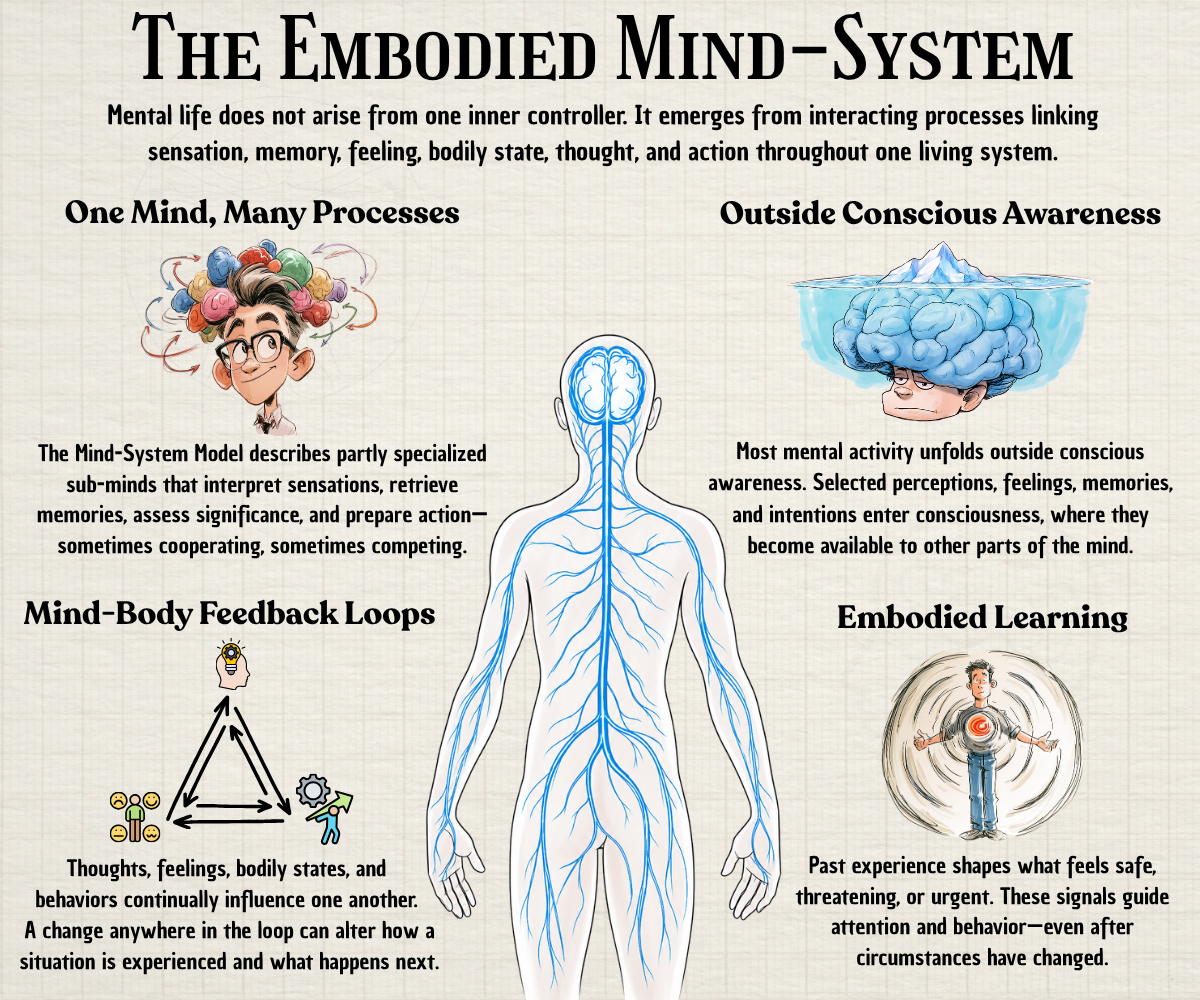
The influences described so far become active through a living system in which sensation, bodily regulation, memory, emotion, motivation, thought, and behavior continually affect one another.
We often speak about “the mind” as though it were a single conscious subject that weighs its options and directs the body. Ordinary experience reveals something less unified. One intention competes with another. Emotion and bodily preparation begin while conscious thought is still deciding what is happening. Mental life becomes more intelligible when understood as the activity of interacting processes rather than one inner controller.
Mental Life Emerges From Interacting Processes:
The Mind-System Model presented by John Yates, known as Culadasa, in The Mind Illuminated offers one contemplative account of this organization. Drawing upon Buddhist analyses while incorporating ideas from cognitive science, it describes the mind as a collection of interacting processes, or sub-minds.
Some sub-minds process sensory information. Others retrieve memories, evaluate significance, construct narratives, form intentions, or prepare actions. The term does not imply miniature people inside the head. It offers a practical way of representing partially specialized processes that respond to different information and pursue different priorities.
Those priorities are emotionally weighted. A possibility associated with fear, desire, shame, affection, or relief carries more motivational force than one with little personal significance. The mind is continually evaluating what matters and what kind of response may be required.
This helps explain familiar internal conflict. Someone can sincerely intend to meditate while attention returns to unfinished work. One process may value honesty while another anticipates rejection and prepares concealment. A person may want intimacy yet become guarded when closeness activates expectations of hurt. Different parts of the system are responding to different concerns, histories, and anticipated consequences.
The mind can function coherently without being perfectly unified. Bodily needs, feelings, values, social concerns, and habits all contribute to thought and action. A personal narrative then gathers these shifting events into the experience of one continuous “I”: I considered the options. I made the decision. I acted.
Contemporary psychology and neuroscience likewise describe mental functions as products of distributed processes, but they do not verify every feature of this model. Culadasa’s sub-minds are used here as a contemplative and teaching framework for understanding the multiplicity visible in meditation and daily life.
Most Mental Activity Occurs Outside Conscious Awareness:
Much of what the mind-body system accomplishes requires no deliberate supervision. We recognize faces, understand sentences, adjust posture, interpret tone of voice, and prepare movements without consciously directing each step. This automaticity makes ordinary life possible.
We often become aware only after a process has produced a result. A judgment appears, an emotion becomes noticeable, or a possible response comes to mind. We can examine what has arisen without witnessing every association, expectation, and bodily change that contributed to it.
Within the Mind-System Model, consciousness functions less like a commanding executive and more like a shared meeting place. Culadasa uses the metaphor of a boardroom: unconscious sub-minds bring selected information into consciousness, making it available to other processes. Further memories, feelings, reasons, intentions, and possible actions may then enter the exchange.
The conscious mind does not stand outside this activity as an independent chairperson. Its importance lies partly in allowing information to circulate. Fear recognized consciously can encounter memories of safety, concern for another person, awareness of consequences, or a value that might otherwise have remained disconnected from the reaction.
Robert Wright proposes a compatible hypothesis in Why Buddhism Is True: feelings may function partly as priority signals. Thoughts and perceptions carrying stronger affective weight may be more likely to capture attention. Anxiety repeatedly returns the mind to an unresolved threat, while shame can make one awkward moment overshadow the rest of a day. This “priority label” account is not an established rule, but it helps explain why mental content often arrives with attraction, aversion, or personal importance already attached.
Routine behavior requires little conscious exchange when the relevant processes already work together. Deliberation becomes more prominent when a situation is unfamiliar or internally conflicted. Some processes may prioritize immediate relief, while others represent long-term consequences, social concerns, or personal values.
A decision does not require unanimity. A working consensus may produce action while contrary inclinations remain as hesitation, temptation, or regret. From the first-person perspective, the result appears as my decision, but that moment is the visible portion of a larger process. Awareness can participate in what happens without originating independently of the system from which the decision emerged.
Thoughts, Emotions, Bodily States, and Actions Form Feedback Loops:
The mind-system does not consist only of thoughts competing inside the head. Mental activity remains inseparable from bodily state, emotion, behavior, and the situation in which a person is acting.
The cognitive triangle, commonly used in cognitive behavioral therapy, illustrates how thoughts, emotions, and behaviors influence one another. An interpretation evokes an emotional response; that emotion makes related thoughts more available and convincing; and behavior changes both the situation and the information upon which later interpretations are based.
An embodied version also includes physical sensation. An ambiguous message from someone important may tighten the chest before a clear interpretation forms. The activation makes Something is wrong feel more credible. Anxiety increases vigilance, threatening possibilities come to mind, and the person rereads earlier messages, seeks reassurance, becomes defensive, or withdraws. Each action changes what follows.
Influence can begin anywhere within the loop. Thought can accelerate the heart, while a racing heart can make danger seem more likely. Anxiety can produce avoidance, and avoidance can preserve anxiety by preventing a feared expectation from being tested. Anger shapes what someone notices, while a hostile interpretation intensifies the anger already present.
Feelings and reasoning are similarly entangled. Feelings help establish what seems worth thinking about, while thought can alter the feelings attached to different possibilities. Remembering a long-term commitment may strengthen care, concern, pride, or guilt enough to compete with an immediate reward. Deliberation can influence behavior without becoming independent of feeling.
Bodily conditions affect the entire process. Exhaustion can make disagreement harder to manage, hunger can shorten patience, and pain can narrow attention. Illness, hormones, medication, and substance use may also alter energy, concentration, and mood.
The cognitive triangle is therefore a loop rather than a fixed sequence. It maps reciprocal influences shaping a moment. The next section follows one possible route through that loop to examine how an encounter becomes meaningful.
Past Experience Shapes Present Bodily Responses:
Developmental history does not survive only as a story that a person can consciously remember. It can shape patterns of attention, arousal, posture, sensation, expectation, and action.
Someone repeatedly criticized may tense when another person’s voice changes. Unpredictable caregiving may make emotional distance feel physically alarming. Following trauma, particular sounds, expressions, locations, or sensations may evoke defensive responses because they resemble conditions that once accompanied danger.
These reactions can begin before the present situation has been consciously evaluated. The body prepares according to what earlier experience taught the system to expect. Tightness, guarded posture, shallow breathing, or a surge of energy then becomes part of the information through which the situation is interpreted.
Interoception refers broadly to how the nervous system senses and interprets conditions within the body. Signals involving heartbeat, breathing, tension, hunger, pain, and visceral sensation contribute to emotion and judgment without carrying one fixed meaning. A racing heart may be understood as excitement, physical exertion, or evidence of danger depending upon context and previous learning.
The claim that emotion or trauma is “stored in the body” points toward this continuing influence but becomes misleading when taken literally. Emotional disturbances are not substances lodged in particular tissues waiting to be released. Their effects persist through distributed patterns involving memory, neural and autonomic activity, bodily sensation, expectation, posture, and behavior. The body participates in learned preparedness.
This is one reason intellectual understanding does not immediately transform an emotional pattern. A person may know that a relationship is secure while the body still prepares for abandonment. Conscious belief and embodied expectation can change at different speeds because they reflect different forms of learning within the same system.
By the time an experience becomes fully conscious, bodily state, past learning, feeling, attention, and memory may already be shaping what it appears to mean. The mind-system does not simply react to a ready-made world; it participates in constructing the world that is experienced.
IV. Constructed Experience — How Do Perception, Feeling, and Thought Shape Our Experience of Self and World?
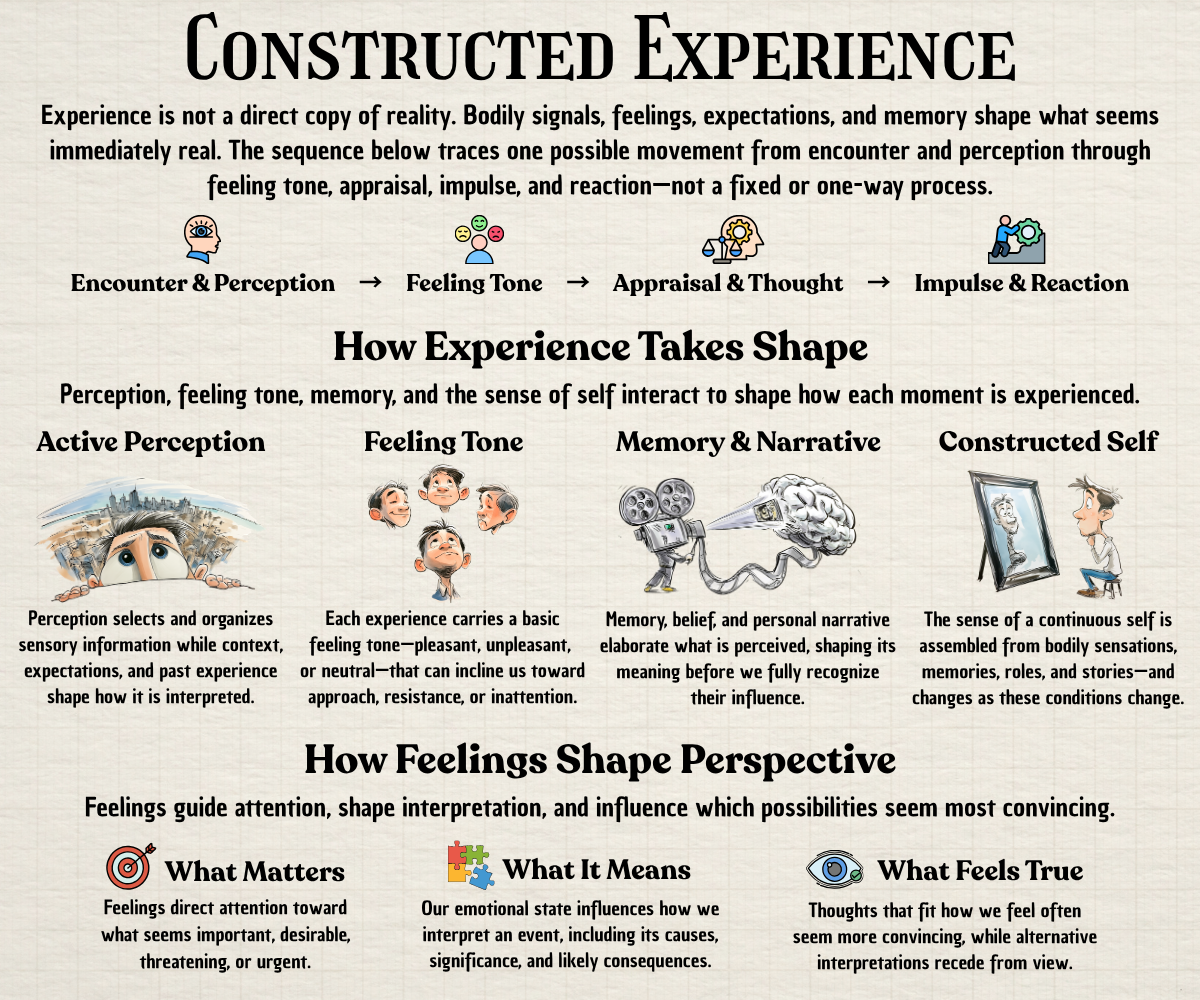
The embodied mind-system does not present consciousness with a neutral recording of reality. Bodily state, attention, memory, expectation, and emotion help select and organize information before an event becomes meaningful.
Experience is neither a perfect copy of the world nor an arbitrary invention. The environment constrains what can be perceived, but what arises also depends upon the conditioned organism encountering it. Two people can participate in the same conversation while hearing different tones, noticing different details, and leaving with different understandings.
For teaching purposes, one movement through a moment can be represented as:
Encounter and perception → feeling tone → appraisal and thought → impulse and reaction
This is not a rigid neurological sequence. Feeling can shape perception, thought can generate new feeling, and bodily reaction may precede conscious interpretation. It is one path through a reciprocal process. This section follows the construction of meaning; the next examines how reaction becomes further conditioning.
Perception Is an Active Construction:
Perception is not simply a window onto an already organized world. Sensory information sets real limits, but it does not arrive with all of its meaning attached. The mind distinguishes objects from background, identifies patterns, directs attention, and estimates what may require a response.
This involves both bottom-up information from the senses and top-down influences such as context, memory, expectation, emotion, and prior knowledge. A familiar word is easier to hear within a noisy sentence because the surrounding language suggests what comes next. An ambiguous expression may appear tired, disapproving, or threatening depending upon the relationship and the observer’s expectations.
Predictive-processing models offer one influential account of this activity. The system uses previous experience to anticipate likely sources and meanings of sensory signals, then revises its expectations when events do not fit. The details remain debated, but the broader insight is useful: earlier learning helps organize perception before deliberate thought begins.
Attention further shapes the experienced world. Someone worried about rejection may notice a delayed reply while overlooking signs of warmth. What receives attention becomes psychologically prominent while much of the environment recedes. We encounter a real world, but through a system oriented toward relevance rather than completeness.
Experience Is Marked by Feeling Tone:
Buddhist psychology describes experience through six senses: the familiar five and the mind, which encounters thoughts, memories, images, and emotions. A remembered conversation can therefore affect us even when the event is no longer occurring.
Contact arises through the meeting of a sense faculty, an object, and the corresponding consciousness. With contact comes feeling tone, or vedanā: the basic registration of experience as pleasant, unpleasant, or neutral.
Feeling tone is not a fully developed emotion. Fear, anger, shame, tenderness, and grief involve richer patterns of bodily activation, appraisal, memory, and motivation. Vedanā refers to a more elemental quality: a sensation, image, sound, or thought feels agreeable, disagreeable, or neither strongly enough to stand out.
Pleasantness inclines the system toward continuation or approach, unpleasantness toward resistance or protection, and neutrality may receive little attention. These tendencies do not determine action. We can approach an unpleasant conversation because it matters or decline a pleasant impulse because of its consequences.
Feeling tone should not be treated as a stage that begins only after perception has finished. Recognition, bodily response, attention, and valence arise rapidly and influence one another. Distinguishing feeling tone is useful because it reveals the simple affective quality that can otherwise disappear inside an elaborate emotion and story.
Feelings Carry Implicit Judgments About What Matters:
As experience develops, basic valence becomes intertwined with emotional appraisal. Feelings do more than add comfort or discomfort to perception. They help evaluate what an event means for the concerns of the person experiencing it.
From an evolutionary perspective, feelings can be understood as rapid, embodied judgments about relevance: good or bad for me, safe or dangerous, inviting or threatening. These evaluations need not become explicit thoughts. Someone can feel uneasy around a person before being able to explain why or feel drawn toward an opportunity before considering its value.
This does not make feelings false or untrustworthy as a class. A feeling is real and may contain important information about needs, values, relationships, and surroundings. Its judgment, however, may be incomplete. Anxiety can register uncertainty without proving catastrophe. Anger may reveal a possible violation without establishing another person’s intent. Shame may signal threatened belonging without demonstrating personal worthlessness.
Feelings are also perspective-dependent. The same crowded room can feel enlivening to one person and oppressive to another. Direct feedback can feel useful when it supports learning and dangerous when it resembles earlier humiliation. Neither response is contained entirely in the room or the words themselves.
Yet affective judgments often seem like properties of what we perceive. A stranger appears dangerous; an expensive object looks impressive; a workplace associated with humiliation feels hostile. Robert Wright describes this as one way feelings shape the perceived “essence” of things. Affect, memory, and story become so closely joined that an evaluation produced within one perspective feels like a fact about the world.
Feelings therefore influence both what matters and what seems true. They deserve neither automatic obedience nor automatic dismissal. They are meaningful but provisional forms of information.
Thought, Memory, and Narrative Elaborate What Is Felt and Perceived:
An initial perception and feeling rarely remain simple. Memory, belief, and imagination begin supplying an explanation. The mind moves from something feels wrong to this is what must be happening and what it means for me.
Schemas and core beliefs developed through earlier experience help organize this interpretation. If disagreement has often preceded rejection, criticism may feel like the beginning of abandonment. If worth depends upon competence, a routine mistake may become evidence of personal inadequacy.
Emotion influences which thoughts and memories become available. Anxiety draws attention toward threat, anger makes disrespect easier to detect, and sadness brings losses closer to mind. Cognitive biases strengthen the emerging account: confirmation bias favors information consistent with existing beliefs, while catastrophizing emphasizes the worst possible outcome. Theory of mind adds inferences about intentions we cannot directly know.
Memory is also reconstructive. Rather than retrieving a complete recording, the mind rebuilds the past from fragments, emotion, knowledge, and present concerns. This flexibility supports learning but can also reshape events around an established narrative.
Consider again the message, “Can we talk tomorrow?” An unpleasant feeling tone arises. Uneasiness suggests that something may be wrong. Memory supplies a previous conflict, a core belief raises the possibility of failure, and imagination creates a future of rejection or loss. Within seconds, four ambiguous words become an emotionally vivid world.
Buddhist psychology calls this multiplication of interpretation conceptual proliferation, or papañca. A simple event becomes surrounded by judgments, explanations, rehearsed conversations, and imagined consequences. Narrative makes planning and coherent identity possible; difficulty arises when one interpretation becomes indistinguishable from the whole reality.
The resulting meaning inclines action. Reassurance, withdrawal, accusation, or distraction will affect the relationship and teach the mind how similar feelings should be handled in the future.
The Sense of Self Is Constructed Along With the World:
The mind constructs not only a meaningful world but also the experience of someone located within it. Events appear threatening, desirable, humiliating, or affirming in relation to a self whose safety, worth, and future seem to be at stake.
This sense of self draws upon bodily continuity, autobiographical memory, social recognition, roles, values, and the stories linking a life across time. A coherent identity serves practical purposes by allowing commitments, relationships, and responsibility to continue beyond the present moment.
Yet narrative identity is selective. It emphasizes certain memories and interprets new events through conclusions such as I am difficult to love, I cannot depend on anyone, or I always fail under pressure. Each conclusion then influences what is noticed and how future events feel.
Identity is also relational. Names, reputations, roles, and social categories arise through participation in a shared world. What counts as success or failure, independence or dependence, is learned among other people.
Feelings help organize this world around “me” and “mine.” Praise warms because it confirms something about me; criticism stings because it threatens my standing or self-conception. Relationships, possessions, beliefs, and roles acquire emotional weight as they become woven into identity.
Buddhist teachings analyze the person through the five aggregates: form, feeling tone, perception, mental formations, and consciousness. Together, these changing processes account for what is experienced as “me” and “mine,” yet none functions as an independent owner directing the others.
The teaching of no-self does not deny that people exist conventionally or that their actions matter. It questions whether these conditioned processes contain a permanent, autonomous essence. The constructed self is a useful but changing organization of embodied, remembered, social, and relational experience.
Difficulty grows when this organization must be continually defended or perfected. A delayed reply threatens not only a relationship but the self who fears being unwanted; a mistake becomes evidence of what someone is. Once acted upon, these constructions produce consequences that shape what the system will perceive and do next.
V. Conditioning, Reactivity, and Suffering — How Do Momentary Reactions Become Enduring Patterns?
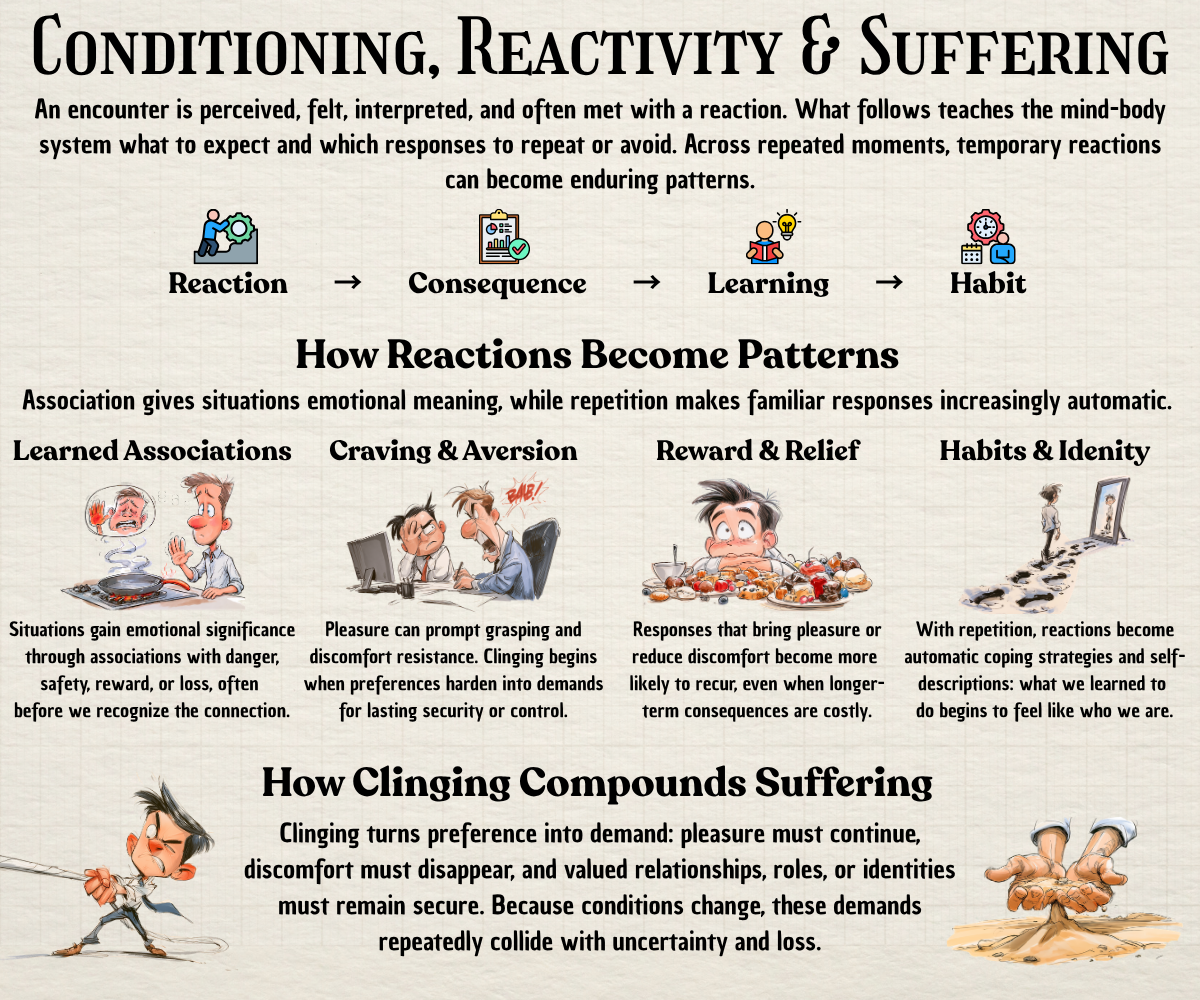
What we do affects the situation, changes how we feel, and teaches the mind-body system what to expect when something similar happens again. Learning theory describes how associations and consequences shape future responses. Buddhist psychology examines how feeling tone develops into craving, clinging, action, and suffering. Together, they show reactivity unfolding within a moment and conditioning accumulating across many moments.
Experience Teaches the Mind What to Fear, Pursue, and Repeat:
Through classical conditioning, something previously neutral can acquire emotional significance because of what has accompanied it. A tone of voice may evoke tension because it resembles earlier criticism; a medical setting may trigger fear after a painful procedure. The body can respond before the association is consciously recognized.
Operant conditioning concerns what happens after we act. Responses followed by pleasure, relief, safety, approval, or another valued consequence become more likely to recur. Someone praised mainly for achievement may learn to rely upon performance for worth, while someone mocked for speaking openly may become guarded.
Reinforcement does not require obvious pleasure. Attention, certainty, belonging, and reduced discomfort can all strengthen behavior. Reinforcement-learning models describe how the system updates expectations about which actions will produce a valued outcome or prevent an unwanted one.
Feelings play a central role. Pleasure can mark an action for repetition; fear can mark a situation for avoidance; relief can tell the system that a protective response worked even when it creates larger problems. This learning is indispensable, but it reflects what produced an outcome under particular conditions. A response can persist after the circumstances that taught it have changed.
Feeling Tone Can Develop Into Craving, Aversion, and Clinging:
Buddhist psychology places feeling tone at a pivotal point in reactivity. Contact occurs, and experience is registered as pleasant, unpleasant, or neutral. This does not dictate the next response, but it gives experience a direction: pleasantness invites continuation, unpleasantness protection or escape, and neutrality may receive little attention.
Feeling tone can then develop into craving. Pleasant experience may produce the demand that it continue, return, or become ours. Unpleasant experience may produce the demand that it stop or remain distant. Neutrality may provoke restlessness and the search for stimulation.
In this broader Buddhist sense, craving includes grasping and aversion. It can appear as the urgent need for reassurance, the refusal to feel uncertain, or the insistence that anxiety disappear before life can continue.
Not every preference or effort to change harmful conditions is craving. We can pursue health, intimacy, meaningful work, safety, or justice without requiring a particular outcome to make us whole. Craving has a more compulsive quality: experience must provide, preserve, confirm, or remove something before the mind will settle.
Craving becomes clinging when this demand hardens around an object, relationship, belief, role, identity, or method of control. Wanting appreciation becomes dependence upon approval; caring about competence becomes the need never to fail.
Broader feelings can accelerate this movement. Anxiety may carry the judgment that danger is approaching, shame may seem to reveal a defective self, and anger may make retaliation feel justified. When the judgment within a feeling appears unquestionably true, reaction feels necessary.
Yet the movement from feeling to craving is conditioned rather than inevitable. Pleasantness can be experienced without grasping, discomfort without immediate resistance, and uncertainty without a frantic search for resolution. In daily life the transition often happens quickly: uneasiness becomes checking, embarrassment becomes defensiveness, and loneliness becomes an urgent demand for reassurance.
Reward and Relief Keep Reactive Patterns in Place:
Many persistent behaviors survive because they work briefly. Avoiding a conversation reduces anxiety for the evening. Checking a phone interrupts boredom. Reassurance quiets uncertainty, while rumination creates the impression that a problem is being controlled.
When behavior produces something desirable, it can be strengthened through positive reinforcement. When it reduces something unpleasant, it can be strengthened through negative reinforcement—learning through relief rather than punishment.
Someone who stays home because of social anxiety feels safer in the short term but gains no evidence that the gathering might have been manageable. The system instead learns that withdrawal ended the threat, making future avoidance more credible.
Experiential avoidance extends this pattern inward. Distraction, compulsive work, substances, reassurance, scrolling, or emotional withdrawal may all provide temporary escape from difficult thoughts and feelings. Any response can be useful in a particular moment; life narrows when immediate relief becomes its organizing principle.
Safety behaviors, worry, and rumination can work similarly, preventing the assumptions beneath them from being tested:
Discomfort → protective reaction → immediate relief → stronger expectation that the reaction is necessary
The person may understand that the pattern is costly while the learning system receives a simpler message: I reacted, and the discomfort decreased. What keeps a pattern alive is often not that it works well, but that it works quickly.
Repeated Reactions Become Habits, Coping Strategies, and Identity:
With repetition, a response requires less conscious deliberation. Avoiding one difficult conversation can become habitual conflict avoidance. Working for approval can develop into perfectionism. Vigilance learned in an unstable environment can continue within relationships that are comparatively safe.
The pattern begins shaping perception as well as behavior. Someone expecting betrayal notices inconsistency while discounting reliability. Suspicion or withdrawal then strains intimacy, appearing to confirm that others cannot be trusted.
Repeated reactions also enter identity. I feel anxious becomes I am an anxious person. I learned to avoid confrontation becomes I am not assertive. A strategy developed under particular conditions begins to feel like a permanent description of the self, discouraging the unfamiliar action through which different learning might occur.
Conditioning unfolds between people as well. One partner’s anxious pursuit may intensify another’s withdrawal, increasing the first person’s alarm. Each protective response becomes part of the environment reinforcing the other.
Buddhist teachings describe dispositions that remain dormant until supporting conditions appear as latent tendencies. Karma also emphasizes that intentions and actions have consequences. Without reducing karma to psychology, its practical insight is clear: what we repeatedly intend and enact affects what becomes easier and more likely.
An enduring pattern is not one decision endlessly repeated by a fixed self. It is a response made increasingly probable through accumulated learning and woven into identity.
Clinging to Changing Conditions Produces Suffering:
Human beings need preferences, commitments, relationships, and dependable support. The problem is not caring but demanding permanent security from conditions that cannot remain fully stable or controlled.
Pleasure changes, bodies age, relationships evolve, and social standing depends partly upon others. As hedonic adaptation makes many improvements familiar, attention settles upon the next absence, risk, or possibility.
Buddhist teachings examine this vulnerability through impermanence, unsatisfactoriness, and no-self. Conditioned experiences change, never come completely under personal control, and cannot provide final security. This does not make pleasure deceptive or relationships pointless. It means they cannot bear the demand that they make us permanently complete or place us beyond loss.
The teaching of the second arrow distinguishes unavoidable pain from suffering compounded through resistance, self-judgment, catastrophic interpretation, and identification. The first arrow may be illness, rejection, grief, or physical pain. The second includes This cannot be happening. I should not feel this. This proves something is wrong with me.
This distinction should not become another source of blame. The second arrow is conditioned rather than freely chosen, and not all pain is internally generated. Poverty, discrimination, violence, disease, and unsafe relationships impose real burdens requiring care, protection, material support, or collective action.
The First Noble Truth recognizes the vulnerability of conditioned life. The Second identifies craving and clinging as forces that compound it. Within a moment, contact and feeling develop into interpretation and reaction; across time, the consequences shape the next moment.
The cycle is self-reinforcing but not closed. If reactivity depends upon conditions, changing those conditions can change what follows. One opening begins when a feeling becomes known before its familiar reaction has fully taken over.
VI. Ethics, Meditation, and Wisdom — How Can These Patterns and Their Conditions Be Transformed?
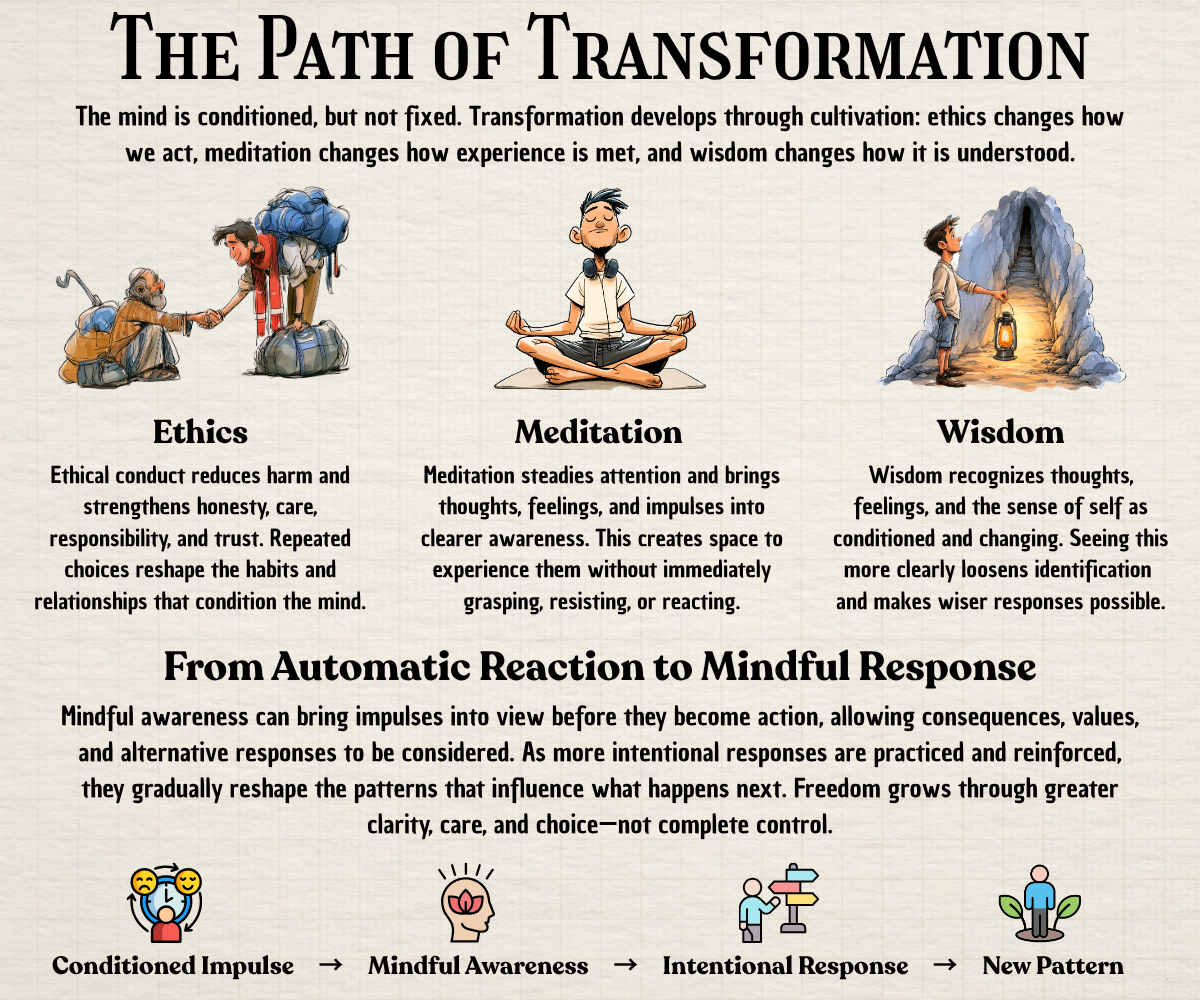
Transformation does not require preventing every unwanted thought, emotion, or bodily response. Nor does it depend upon an inner controller overpowering the rest of the mind. It occurs as new intentions, actions, relationships, and experiences teach the system another way of responding.
Buddhism organizes this process through the Threefold Training. Ethics changes what we enact and reinforce. Meditation changes how clearly experience is known and how automatically feeling becomes reaction. Wisdom changes the assumptions through which experience becomes craving and suffering.
Transformation Occurs Through Cultivation, Not Sheer Willpower:
We often assume that understanding a harmful pattern should be enough to stop it. When it returns, its persistence can feel like weakness or insincerity. The Mind-System Model offers another explanation: conscious intention may represent only one part of a system in which other processes still associate the behavior with pleasure, protection, relief, or belonging.
Those processes cannot always be persuaded by the correct idea. Someone may know that a relationship is secure while feeling abandonment in every silence. They may understand that a mistake is survivable while the body prepares for humiliation. New beliefs become credible more deeply when supported by repeated experience.
Transformation therefore requires intentional cultivation. The Buddhist term bhāvanā refers to developing beneficial qualities. Rather than commanding the mind to become calm, compassionate, or wise, practice creates conditions in which those capacities can arise more often and exert greater influence.
Plasticity makes this possible, but it does not mean anyone can reshape the mind without limit. Change depends upon repetition, intensity, context, health, resources, and previous learning.
New learning often begins when a familiar prediction is not confirmed. A person feels anxiety without escaping and discovers that it can rise and fall. An urge for reassurance is not enacted, and uncertainty remains uncomfortable without becoming unmanageable. One experience rarely overturns years of conditioning, but repetition can make another response increasingly believable.
Environment and relationship remain part of cultivation. Sleep, community, healthcare, stability, and freedom from ongoing harm affect the resources available for change. Transformation develops through practice within conditions that support or obstruct what someone is trying to learn.
Ethics Changes the Conditions Shaping the Mind:
Within Buddhism, ethics is not merely preparation for meditation or obedience to an external code. It is a form of mental, relational, and behavioral training.
Speech and action shape the situations we inhabit and the tendencies we rehearse. Dishonesty creates fear of exposure, aggression leaves conflict behind, and compulsive behavior strengthens the expectation that discomfort requires immediate relief. Ethical restraint interrupts actions that would reinforce these conditions.
The Noble Eightfold Path expresses this dimension through right speech, right action, and right livelihood. Honesty can support relationships with less concealment. Generosity rehearses responsiveness to others. Patience allows frustration to be felt without being discharged through harm. Repair after conflict can teach that mistakes do not always end belonging.
Feelings remain important but do not provide the final verdict. Anger may reveal that a boundary has been crossed while leaving open how to respond. Guilt may call attention to harm without requiring lifelong self-condemnation. Affection can motivate care while becoming possessive. Ethics allows feelings to inform action without automatically letting the strongest one decide it.
Values give this training direction. Ethical reflection asks not only How can I feel better? but What response reduces harm and supports the life and relationships I want to cultivate?
Non-harming does not require passivity. It may involve setting boundaries, leaving an unsafe relationship, challenging exploitation, or changing an unjust institution. Community also provides encouragement, correction, accountability, and examples that individual effort cannot supply. Ethics changes the mind partly by changing the life and relationships in which it operates.
Meditation Changes How Experience Is Met:
Meditation does not prevent thoughts, emotions, sensations, or impulses from arising. Its distinctive contribution is making these processes more clearly knowable while they occur.
Concentration stabilizes attention so it is less continually captured by whatever appears threatening, pleasurable, or novel. Mindfulness broadens awareness to include bodily sensation, feeling tone, emotion, thought, and urge. Together, they make a reaction easier to recognize while it is forming.
Ordinarily, an unpleasant experience and the demand to escape it can seem inseparable. With greater awareness, a practitioner may recognize pressure in the chest, unpleasant feeling tone, the thought Something is wrong, an urge for reassurance, and the hand reaching toward the phone as related but distinguishable events.
Mindfulness does not insert an unconditioned self between them. Awareness becomes another condition within the sequence. Once feeling and urge are known, other information can enter the response: uncertainty about the interpretation, likely consequences, another person’s needs, or a value the practitioner wants to honor.
Feeling also becomes available for examination. Fear can be felt without treating danger as established. Shame can be recognized as a painful state rather than proof of defective identity. Desire can be experienced without assuming that its object will provide what it promises. Its implicit judgment becomes visible enough to consider rather than simply obey.
Contemporary psychology describes related capacities through decentering, cognitive defusion, and metacognitive awareness. A thought can remain present without becoming the only description of reality; an emotion can remain meaningful without becoming an instruction.
Acceptance acknowledges what is already present before deciding how to respond; it does not require liking the experience or allowing harm to continue. Equanimity permits pleasure without immediate grasping and discomfort without reflexive resistance. Loving-kindness and compassion practices cultivate emotional and relational alternatives rather than merely suppressing hostility.
These moments create new learning. An urge arises without becoming action, discomfort is felt without immediate avoidance, and a difficult emotion changes without being forced away. More of the system can gradually learn that the familiar reaction is not the only available protection.
Practice must still be adapted to the person. Meditation can sometimes intensify distress, particularly when trauma or significant mental-health concerns are present. Skilled teaching, psychotherapy, medical care, grounding, movement, or relational support may be more appropriate than increasing practice. Meditation is one condition among many; its distinctive role is making experience more clearly available to awareness as it unfolds.
Wisdom Changes How Experience Is Understood:
Awareness alone does not determine how experience will be interpreted. Someone can become highly attentive while remaining organized around fear, control, or self-judgment. Wisdom concerns the understanding that guides attention and action.
Within Buddhism, wisdom develops through insight into impermanence, unsatisfactoriness, not-self, and dependent arising. Sensations, moods, thoughts, relationships, and identities change. Suffering grows when changing conditions are expected to provide unchanging security. Bodily states, perceptions, emotions, and intentions arise through conditions rather than obeying an independent owner.
Wisdom also changes how feelings are understood. A feeling can be respected without being mistaken for a complete assessment of reality. Its judgment reflects a particular body, history, set of concerns, and point of view. Anxiety may attempt to protect us without accurately predicting what will happen. Anger may reveal pain or injustice while narrowing perception. Pleasure may enrich a moment without being able to make it last.
Intellectual agreement is not enough. Someone may believe that everything is impermanent while reacting to change as a personal violation. Meditation makes these principles available to observation, ethics gives them expression through action, and repetition allows understanding to reach processes organized around older expectations.
The Third Noble Truth points toward the possibility that craving and clinging can cease. The Fourth describes the path through which that possibility is cultivated. Wisdom reframes freedom not as perfecting the conditioned self but as loosening the grasping, resistance, and identification organized around it.
Freedom Means Greater Responsiveness, Not Complete Control:
Freedom is often imagined as mastery over mental life: unwanted thoughts disappear, difficult emotions remain controlled, and the mind responds exactly as intended. This ideal repeats the conscious-CEO model the framework has questioned.
A more realistic freedom is the growing capacity to experience thoughts, feelings, and impulses without being compelled to believe or enact them. Fear may arise without deciding every action, criticism may hurt without becoming a verdict on the self, and anger may be heard without controlling speech.
Psychology describes part of this capacity as psychological flexibility: remaining in contact with present experience while responding according to the situation and one’s values. The goal is not emotional invulnerability but a wider and more appropriate range of responses.
This is where agency belongs within the framework. It does not stand outside causation as a power directing the mind from above. Agency grows as awareness, reflection, skill, support, and practiced values become more available within the processes shaping action. We do not choose every feeling, but we can cultivate conditions under which more than the strongest immediate impulse influences what follows.
Freedom remains uneven. Old patterns may return during fatigue, grief, illness, or relational threat without erasing what has been learned. Progress may appear as earlier recognition, shorter reactivity, less harmful behavior, or more reliable repair rather than the disappearance of difficulty.
Freedom also includes recognizing when inward practice is insufficient. Meditation cannot make abuse safe, provide medical treatment, erase poverty, or replace collective action. Acceptance does not require abandoning protection, protest, ambition, or change.
Greater freedom looks less like total control and more like conscious participation. We cannot determine every condition, but awareness, intention, and action become part of the conditions shaping what follows.
The Mind Is Conditioned—but Not Fixed

Human experience takes form through many layers of influence. Evolution gives us broad sensitivities to danger, pleasure, belonging, status, intimacy, and care. Development attaches them to particular relationships, expectations, and identities. Culture and material conditions shape what is possible and what appears valuable. An embodied mind-system brings these influences into the present through bodily response, feeling, attention, thought, and action.
The world we experience is not simply received. Perception selects, feeling assigns significance, and memory and thought elaborate what events seem to mean. A sense of self forms within the same process, organized around what appears desirable, threatening, affirming, or shameful.
Our reactions become part of the conditions shaping what follows. What brings reward or relief becomes more likely to recur. Repetition becomes habit, habit influences perception, and perception reinforces identity. Understandable efforts to find pleasure, escape pain, and protect the self can develop into enduring patterns of craving, aversion, and suffering.
No one independently chose all the conditions from which these patterns arose. Recognizing this can soften shame without eliminating responsibility. Causation is not fatalism: relationships, environments, attention, intention, and action can introduce different conditions and teach the system another way of responding.
Ethics changes what we rehearse and the consequences we create. Meditation makes feeling, thought, and impulse more available to awareness before they become action. Wisdom reveals that their immediate judgments are conditioned, partial, and changing rather than final descriptions of reality or self.
Meditation does not remove us from the human condition or place a perfected self in control. It helps us notice more of the conditions shaping the next response. A familiar feeling may still arise, but it does not always have to produce the same familiar action.
This framework is best used as a map, not a verdict about any particular person. Its value lies in helping us ask more precise and compassionate questions: What conditions are active? What is this feeling trying to protect or pursue? Which interpretation has become compelling? What response is being reinforced? And what conditions might allow a wiser response to become possible? Seen this way, understanding the mind does not reduce a person to a collection of causes. It helps locate the places where care, practice, relationship, and responsibility can make a difference.